


Why a Backyard Water Feature Can Transform Your Space
The sound of moving water changes how an outdoor space feels before you even spot the source. A soft trickle beside the patio can muffle traffic noise and cool the mood on a hot afternoon. It gives your eye a place to rest, too.
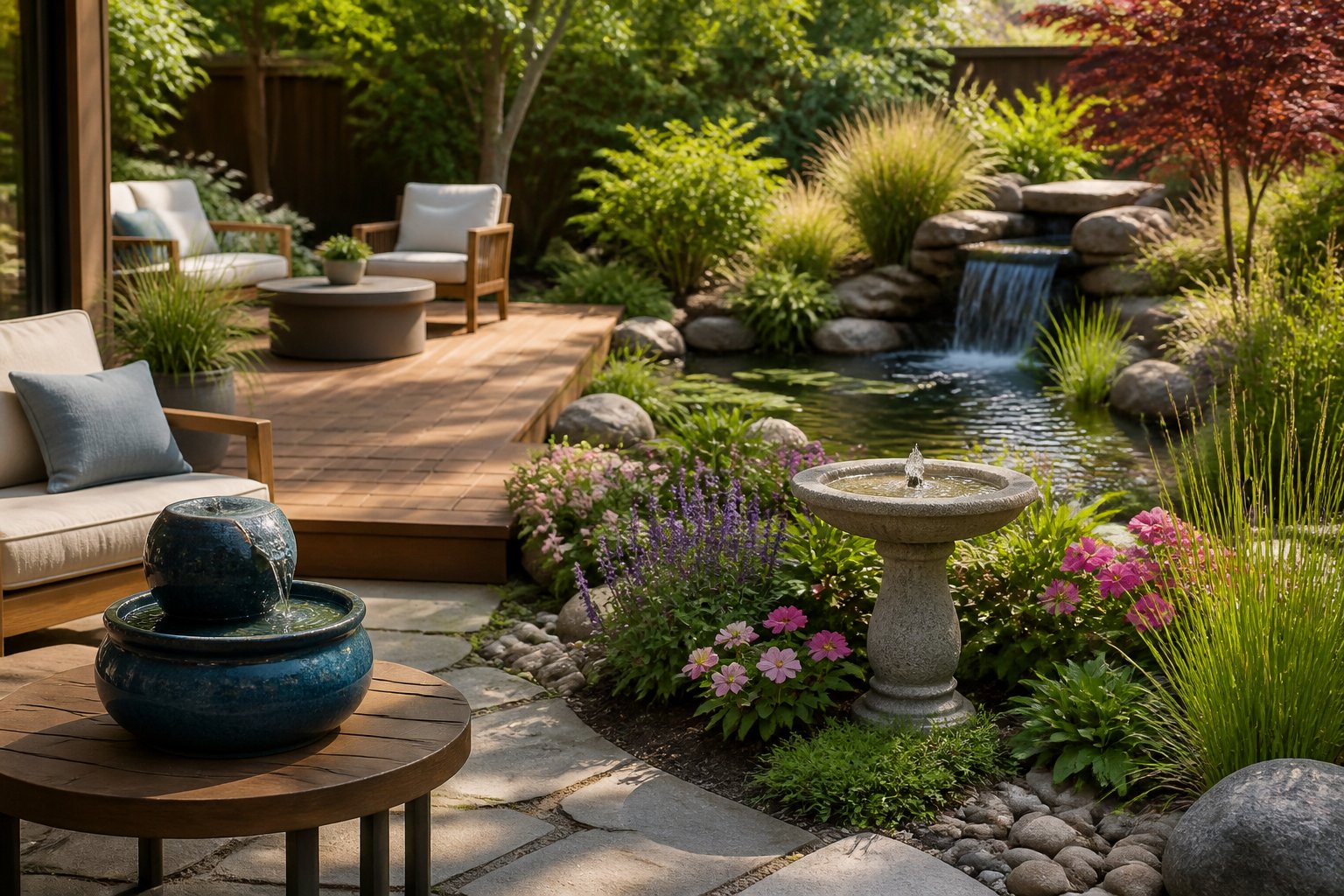
Here’s the short version: a solar container fountain or bubbling rock will cost you under $200 and about a weekend, a pondless waterfall usually runs $500 to $3,000 and hides all the water in a gravel reservoir, and a stocked pond is a living system that asks for year-round attention. Each one brings a different sound, look, and a whole different level of maintenance.
This guide walks through those options in order of cost and complexity. I’ll cover the hidden details that trip people up: power access, drainage, winter shutdown, and the point where a DIY build just isn’t worth the hassle.
Key Takeaways
- Match sound, scale, and power access to your site before you shop. Those three factors rule out most bad choices.
- Container fountains, bubbling rocks, and rain chains give you real water sound for under $200 with barely any digging.
- Pondless waterfalls hide the water in a buried reservoir. Ponds add fish, plants, filtration, and steady seasonal work.
Choose the Right Feature Before You Set a Budget
Water feature design starts with three questions: what do you want to hear, how much room do you have, and where’s the nearest outlet? If you answer those honestly, half the water feature ideas on the market disappear from your list. That saves you money before you even spend a dime.
Match Water Sound, Scale, and Style to the Site
People usually underestimate sound. A small bubbler beside a bench gives you a gentle burble that you notice only when the yard goes quiet. A three-foot drop into a rock basin gives you a rush you’ll hear from inside the house if the windows are open.
Scale matters just as much. A 24-inch urn fountain looks like a nice accent on a small patio, but it gets lost in a wide open lawn.
Style should follow what’s already there. A boulder-and-gravel water feature fits right next to a rock garden or informal plantings. A squared concrete basin or spillway suits a modern setting with clean paving lines.
If your outdoor dining area is the main gathering spot, put the water within about 10 feet of the table. That way, it competes with conversation instead of fading into the background.
Compare DIY Difficulty, Power Access, and Ongoing Costs
Almost every feature needs a pump. A submersible pump sits in the water and pushes it up through tubing.
Small pumps (80 to 250 GPH) work for container gardens and bubbling rocks. Waterfalls need way more flow, and the pump is usually the single biggest hardware cost.
| Feature type | Typical spend | Pump need | Ongoing work |
|---|---|---|---|
| Container garden fountain | $60 to $200 | Solar or 80 to 150 GPH | Top off water, clean pump monthly |
| Bubbling rock | $75 to $250 | 150 to 250 GPH | Rinse basin, refill weekly in heat |
| Wall or tiered fountain | $200 to $1,500 | Included, low-voltage pump common | Descale, winter cover |
| Pondless waterfall | $500 to $3,000 | 2,000 to 5,000 GPH | Clear debris, top off, annual flush |
| Stocked pond | $1,000 to $6,000+ | Sized to turn volume hourly | Filters, water testing, seasonal care |
Running costs are modest but real. A small pump running nonstop usually adds a few bucks a month to your electric bill. A big waterfall pump can add $15 to $30 in summer.
A low-voltage pump with a transformer is the safer choice if you have to run a cord across planted ground. Solar removes wiring entirely, but stops when the sun disappears.
Plan for Drainage, Utilities, and Safe Placement
Call 811 before you dig anything deeper than a shovel blade. It’s free, takes a couple of days, and is way cheaper than hitting an irrigation line or gas service.
Avoid low spots where runoff collects, or your reservoir will fill with muddy water every storm. Skip the ground directly under a maple or oak unless you enjoy scooping leaves. Partial shade is ideal because full sun all day feeds algae and heats the water.
Every feature needs a GFCI outlet. If you don’t have one within reach, budget $200 to $500 for an electrician. Factor that in before you fall in love with a design.
Open water carries real risk around toddlers and unsupervised pets. Pondless and bubbling designs keep their water below grade in gravel. That’s why so many families with young kids go that route.
Small-Scale Ideas Under $200
This is where most people should start. An affordable water feature built around a container, a drilled rock, or a rain chain gives you real water sound for the cost of a nice patio chair. None of them require you to dig a permanent hole in your yard.
Create a Solar Container Fountain
A container water garden is the easiest entry point. Take a glazed pot, half whiskey barrel, or galvanized stock tank, seal any drain hole, and drop in a small pump with a fountain head.
Solar-powered fountains skip the wiring completely. A floating solar pump costs $25 to $60 and works well in a container pond if the panel gets four or more hours of direct sun. The spray will stall on cloudy days unless you buy a model with a battery.
Add plants and you’ve got a living thing. Water lettuce or water hyacinth float and shade the surface. Hornwort oxygenates from below. A single small water lily gives you a bloom if the pot gets 4 to 6 hours of sun.
Two or three goldfish will eat mosquito larvae in a 50-gallon tank, but you’ll need dechlorinated water and a winter plan if you live somewhere cold. Honestly, most container fountains stay planted only, which is simpler anyway.
Placement warning: a 50-gallon container weighs over 400 pounds when full. Set it where you want it before you add water, and make sure a deck can handle the load.
Build a Bubbling Rock With a Hidden Basin
The bubbling rock fountain is probably the best value in this whole category. Water rises through a drilled stone, sheets over the surface, and vanishes into decorative gravel below. No standing water, no mosquito habitat, no scooping leaves out of a pool.
The mechanics are simple. A buried reservoir basin holds the water, a submersible pump sits at the bottom, and flexible tubing feeds the rock above.
A guide from Backyard Focus puts a beginner-level bubbling rock at $75 to $150 using a 15 to 20 gallon basin and a 150 to 250 GPH pump.
Here’s what you’ll need:
- One pre-drilled boulder or large river rock (or drill your own with a masonry bit, going slow and using water as a coolant)
- A reservoir basin or heavy plastic tub, 15 to 20 gallons
- Small submersible pump, 150 to 250 GPH
- 1/2-inch flexible tubing
- Hardware cloth or a rigid grate to span the basin
- River rocks and decorative gravel to hide the hardware
- GFCI outlet access
Level the basin carefully. If it tilts, water runs off one side and the reservoir drains faster than you can refill it. Plan on topping it off every few days in hot weather, since evaporation is faster than most people realize.
Turn Rainfall Into a Decorative Feature
Rain chains cost $30 to $120 and replace a downspout section with a chain of cups or links. Water walks down the chain instead of rushing through a pipe, and on a steady rain the sound is genuinely pleasant.
They only work in rain, which is the honest limitation. Pair one with a gravel-filled basin or a small dry creek bed below so the runoff drains away from your foundation.
A birdbath deserves mention here too. Add a $20 solar bubbler disc and a still bath becomes one of the better bird-friendly fountains you can own. Moving water attracts far more birds than standing water and slows algae.
Tabletop fountains and small self-contained fountain units fill the same niche indoors or on a balcony, usually for $50 to $150.
Fountains and Vertical Features for Patios and Tight Yards
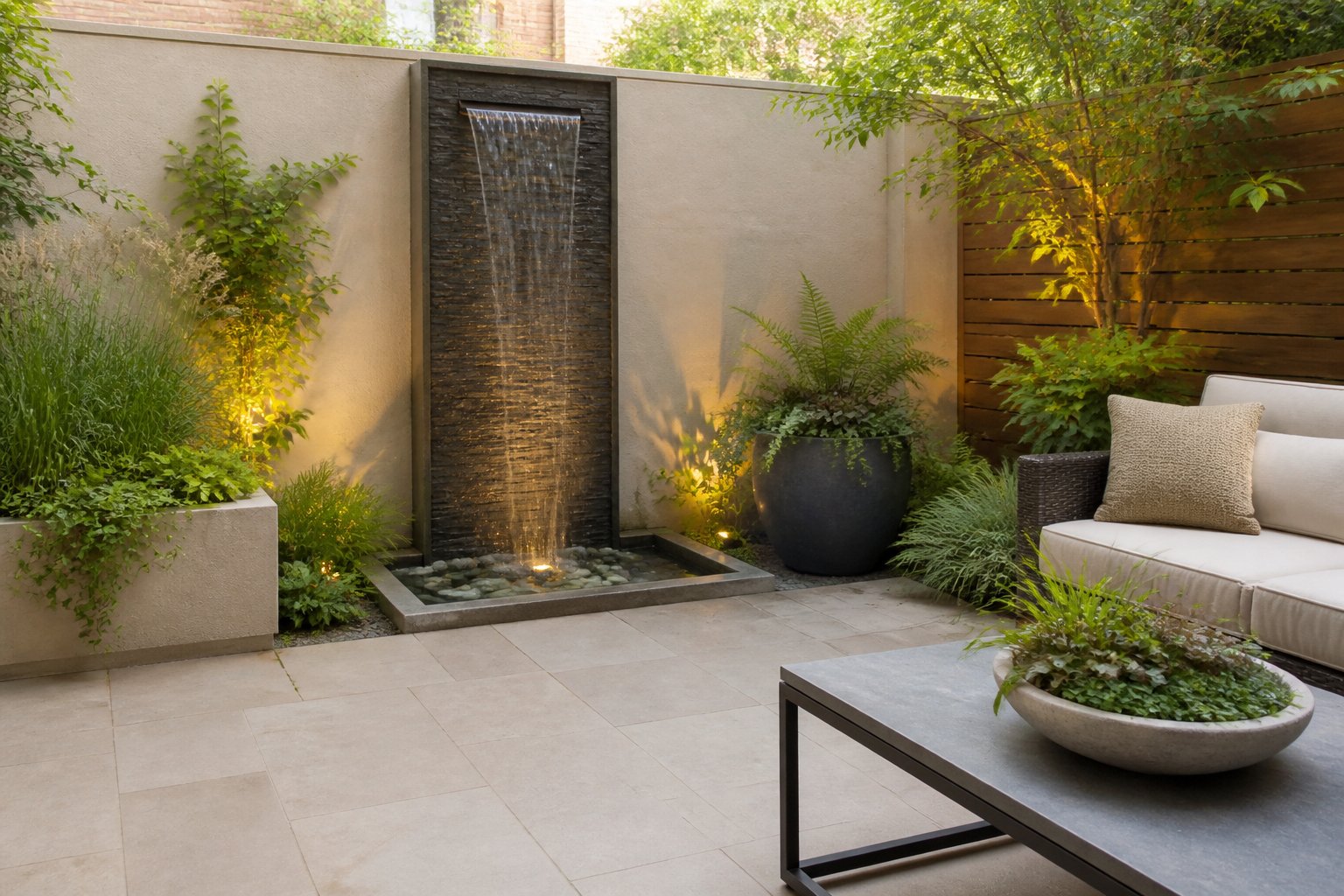
When floor space is tight, build upward. Wall-mounted water features, tiered garden fountains, and lit spillways all deliver a strong presence from a footprint measured in inches, not feet.
Use a Wall Fountain to Preserve Floor Space
A wall fountain hangs on a fence, house wall, or privacy screen and sticks out just 6 to 12 inches. That’s a practical choice on a narrow patio or in a townhome courtyard where a freestanding piece would block your path.
Most wall fountains are self-contained. There’s a hidden basin at the bottom, a small pump inside, and a spout or spill lip up top.
Cast resin and fiberglass units usually run $150 to $600. They’re light enough for one person to hang.
Cast stone or concrete wall fountains can weigh over 200 pounds. You’ll need solid anchors in framing or masonry for those.
Check the mounting surface before you buy anything. A cedar fence panel won’t hold a heavy stone fountain; you’ll need a post or a reinforced backer board.
Make a Traditional Tiered Fountain the Focal Point
The classic tiered fountain fills a circular patio, courtyard, or the end of a sightline with a strong, symmetrical shape. It’s hard to beat for that traditional look.
Expect to pay $300 to $1,500 for a two or three-tier cast stone unit in the 3 to 5 foot range. The sound is a layered splash—more lively than a bubbler, quieter than a waterfall.
Tiered basins collect leaves and grit fast, so get ready to wipe the bowls out every couple weeks. In freezing climates, drain the fountain and cover it before the first real freeze—expanding water in concrete is what cracks these things.
Add Contemporary Spillways and Illuminated Water Walls
Modern water features swap splash for a clean sheet of water. A water wall sends a thin film down a flat panel of stainless, corten steel, or slate, making a low, steady hiss instead of a splash.
Spillway bowls and blade water spouts do something similar. They drop a clear ribbon of water into a basin or over a stone wall feature.
If you already have a retaining wall, adding a water feature there makes sense since half the structure and plumbing chase are ready to go. Add warm-white LED lights at the spill lip and the feature works after dark, which is honestly when most people are out on the patio.
Fieldstone or decorative rocks at the base soften the edge where hardscape meets planting. Budget $600 to $3,000 for a fabricated water wall installed—more if the wall itself is new construction.
Pondless Waterfalls and Streams With Bigger Impact
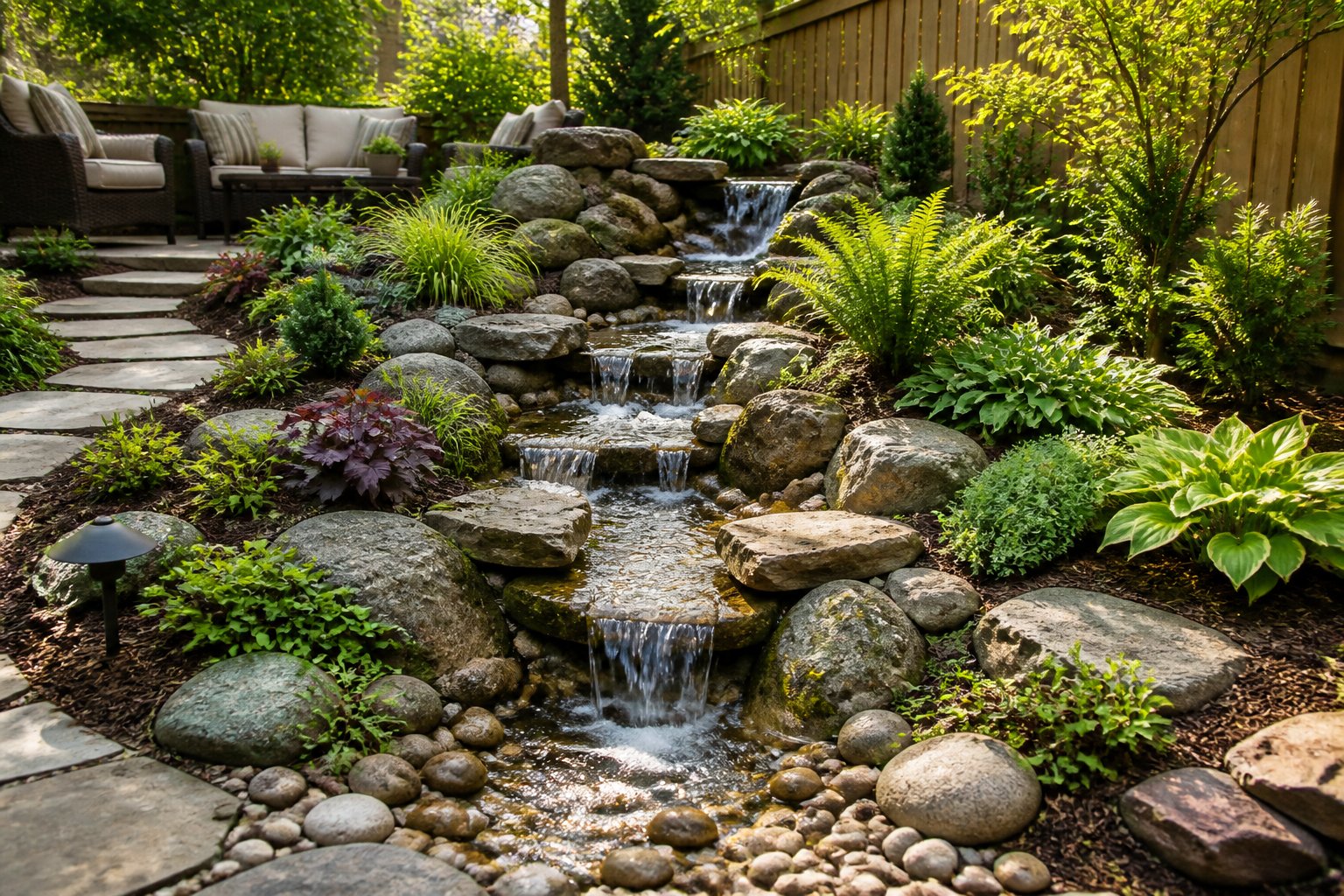
A pondless waterfall gives you the sight and sound of a real cascade, but stores the water underground in a gravel-filled reservoir. It’s a sweet spot for a lot of yards: dramatic movement, no open pool, and no fish to keep alive.
Build a Compact Pondless Waterfall
The idea is simple enough. Dig a basin at the low end, line it, fill it with rock or a modular basin box, run a big pump from the bottom up to a spillway at the top, and let gravity do its thing.
Even a small elevation change works. A drop of 12 to 18 inches makes plenty of sound; you don’t need a hillside.
If your yard’s dead flat, build a low berm from the soil you dig out and plant it so the mound blends in. Size the reservoir generously—aim to hold at least three times the water sitting in the stream and falls, so the pump never runs dry as water evaporates.
Diy waterfall build sequence:
- Mark the stream path and basin with a garden hose or spray paint.
- Excavate the reservoir first, then the stream channel above it.
- Lay geotextile underlayment, then a 45 mil EPDM rubber liner in one continuous piece if you can.
- Set the pump in the basin and run flexible tubing up to the top spillway.
- Fill the basin with washed gravel or set a modular basin, then cap with a grate.
- Place boulders and flat spill stones from the top down, testing flow as you go.
Budget $500 to $1,500 for a compact DIY build. If you hire a contractor, expect $3,000 to $8,000 installed.
Shape a Natural-Looking Cascade and Stream Bed
The difference between a convincing garden waterfall and an obvious pile of rocks is variety. Use stones of three or four sizes, bury the bottom third of each boulder so nothing looks stacked, and let the channel wander instead of running straight downhill.
Set spill stones with a slight forward tilt and a lip that sticks out past the rock behind it. That’s what makes water fall cleanly instead of clinging and dribbling down the face.
Run a dry creek bed of river rock out from the visible stream so the feature blends into a larger drainage. Tuck water-loving plants and native species along the edges—natives handle your rainfall and temperature swings with way less babysitting. Sedge, iris, and ferns usually work at the wet margins in most regions.
Know When a Waterfall Kit Is Worth It
A waterfall kit bundles the basin, pump, liner, tubing, and fittings for one flow rate. Kits usually run $400 to $1,200 and take the guesswork out of pump sizing, which is where most first-time DIY water features trip up.
Buy a kit if this is your first boulder water feature, if you’re not confident matching pump GPH to head height, or if you want a modular basin instead of a gravel-filled pit. If you already have stone, need a longer stream than the kit supports, or want to oversize the reservoir, skip the kit and buy parts separately.
Don’t cheap out on the pump. An undersized pump running at full tilt all summer will burn out early and take the fun out of the whole project.
Living Ponds and Water Gardens
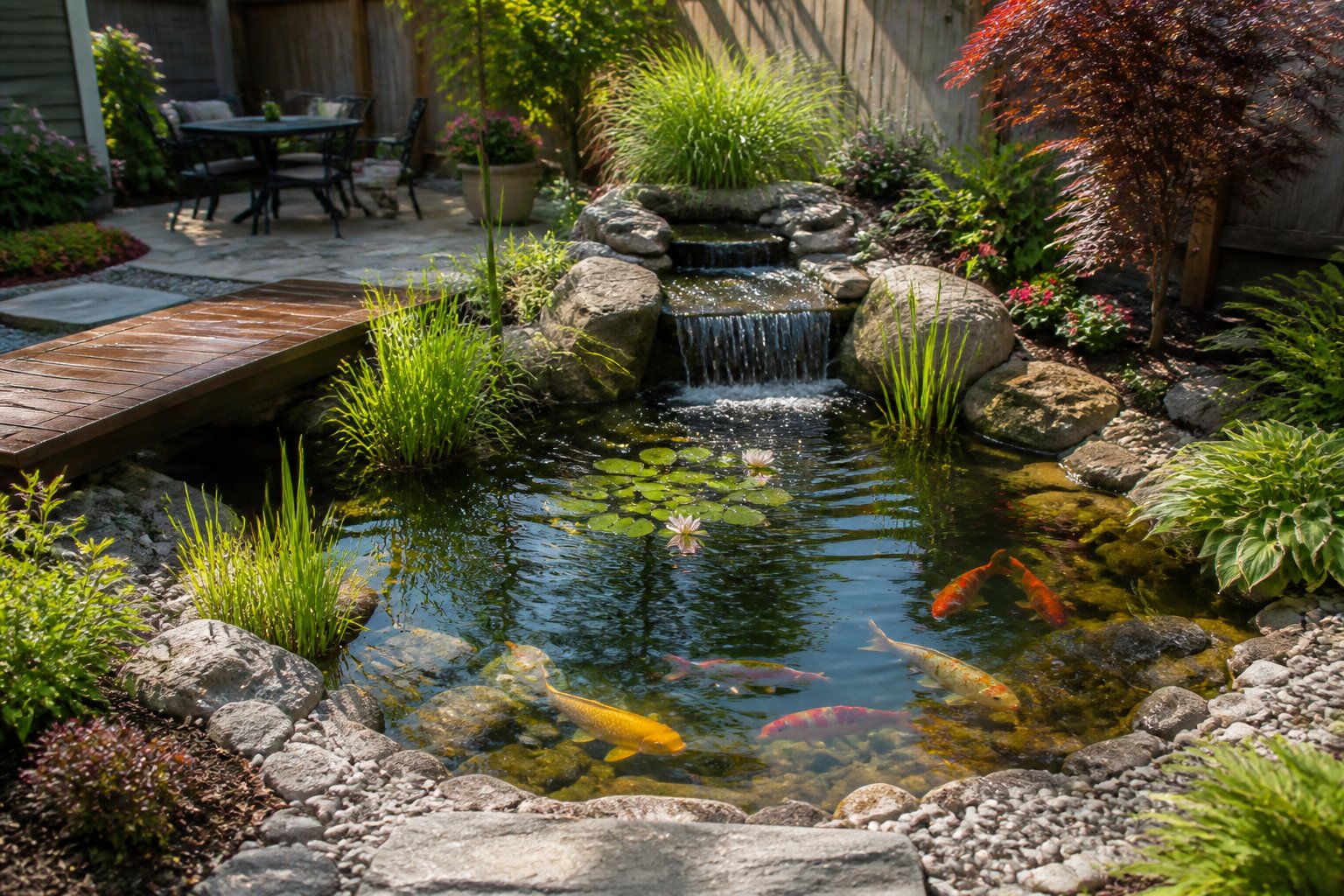
A backyard pond is the only option on this list that’s genuinely alive, and that cuts both ways. You get plants, fish, dragonflies, and reflection—but also water testing, filter cleaning, string algae in June, and a winter plan.
Start a Small Pond With Plants and Goldfish
A small pond about 6 by 8 feet and 18 to 24 inches deep is a practical DIY starting point. You’ll need geotextile underlayment, a 45 mil EPDM liner, edging stone, a pump sized to turn the full volume every hour or so, and a filter.
Goldfish are way more forgiving than koi. Four or five small goldfish suit a few hundred gallons, they tolerate temperature swings, and they’ll eat mosquito larvae without much help from you.
Plants do most of the work for water clarity. Cover 50 to 60 percent of the surface with aquatic plants—water lilies for shade, marginal plants like iris and rush on a shallow shelf, and hornwort underwater as an oxygenator.
Give it time to settle. Run the pump and filter for at least two weeks so helpful bacteria colonize the filter media before you add any fish, and test until ammonia and nitrite read zero.
Understand the Commitment Behind a Koi Pond
Koi aren’t just big goldfish. They grow to 18 to 24 inches, produce a lot of waste, and eat most soft aquatic plants, so a true koi pond needs more volume, stronger biological filtration, and often a UV clarifier to keep green water under control.
Plan on 1,000 gallons minimum and at least 3 feet of depth in cold zones so fish can overwinter below the ice line. Expect $2,000 to $8,000 for a proper build, plus a heater or de-icer up north.
The work never really stops: skimmer baskets weekly, filter rinses monthly, water tests, netting for leaves in fall, and a spring startup. Herons and raccoons are a real threat to expensive fish, so plan for netting or deep shelter areas.
Design a Wildlife Pond or Natural Swim Pond
A wildlife pond is the low-input option. Skip the fish, add a gently sloping beach edge so frogs and birds can get in and out, plant natives around the margins, and let the system balance itself with minimal filtration.
Natural swim ponds take the same idea much further. A swimming zone sits beside a planted regeneration zone, where gravel beds and aquatic plants filter the water biologically instead of with chlorine.
They’re beautiful and expensive—usually $50,000 and up installed—and local permitting can be a headache. Check your local codes early. Many cities treat water over a certain depth as a pool and require fencing or a permit.
Japanese, Rustic, and Architectural Design Directions
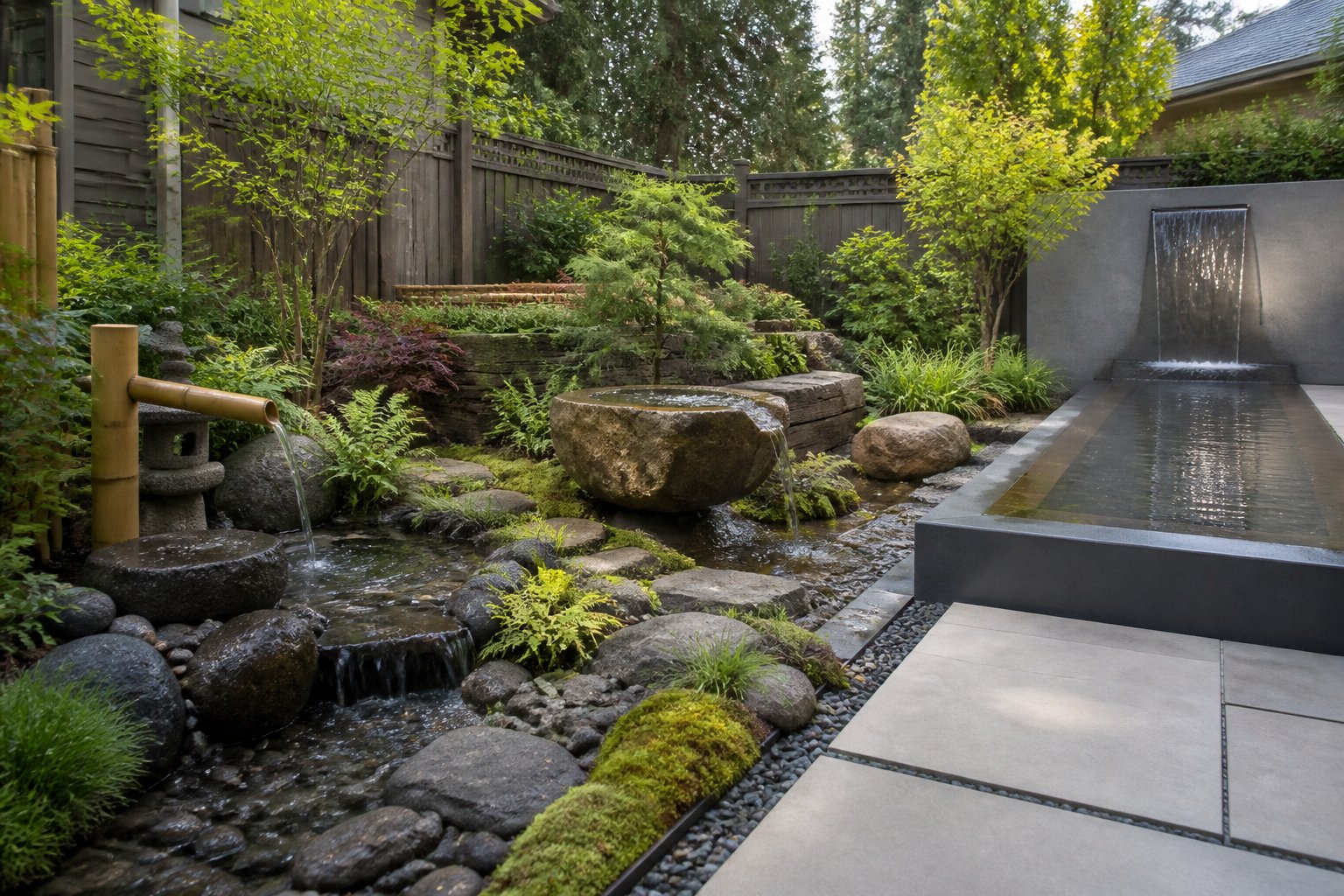
Style comes last, and honestly, it should follow your house and existing plantings, not fight them. The three directions below cover most outdoor living space vibes: quiet and restrained, rugged and natural, or clean and geometric.
Create a Quiet Japanese-Inspired Water Accent
A tsukubai is a low stone basin fed by a bamboo spout, usually placed where you have to crouch to use it. It holds maybe two gallons, needs just a tiny pump, and gives you the softest sound in this whole article.
The shishi-odoshi, or Japanese deer scarer, is the pivoting bamboo tube that fills, tips, empties, and knocks against a stone. That knock repeats every 20 to 40 seconds. Some people find it meditative, others find it maddening after a while—so listen to one before you build it.
Keep the setting spare. As Homes and Gardens notes on Japanese garden design, the water should look at ease in its setting, not announced. Moss, a single maple, a couple weathered stones, and restraint do more than extra hardware.
Blend Stone and Planting for a Natural Setting
A natural water feature succeeds on details most people skip. Bury boulders a third deep, mix rock sizes, and never ring the edge with same-sized stones like a necklace.
Pull planting right to the water line so the transition disappears. Ferns, sedges, and low shrubs break up hard edges and hide liner or basin rims.
Weathered fieldstone and locally quarried rock look native because they are. Hauling in stone from another region is one of the fastest ways to make a boulder water feature look imported.
Use Geometry and Materials for a Modern Statement
A modern water feature depends on precision. Straight lines, a level spill lip, and a single material choice do the work here, so a slightly out-of-level edge shows immediately.
Corten steel weathers to a rust-orange patina and pairs well with concrete and grasses. Stainless reads cooler and crisper.
A stone wall water feature in cut, stacked stone splits the difference between rustic and architectural. Keep the planting simple, repeat one or two grasses or sculptural specimens, and let the geometry carry the outdoor oasis instead of filling every gap.
Frequently Asked Questions
What are some affordable water feature ideas for a small backyard?
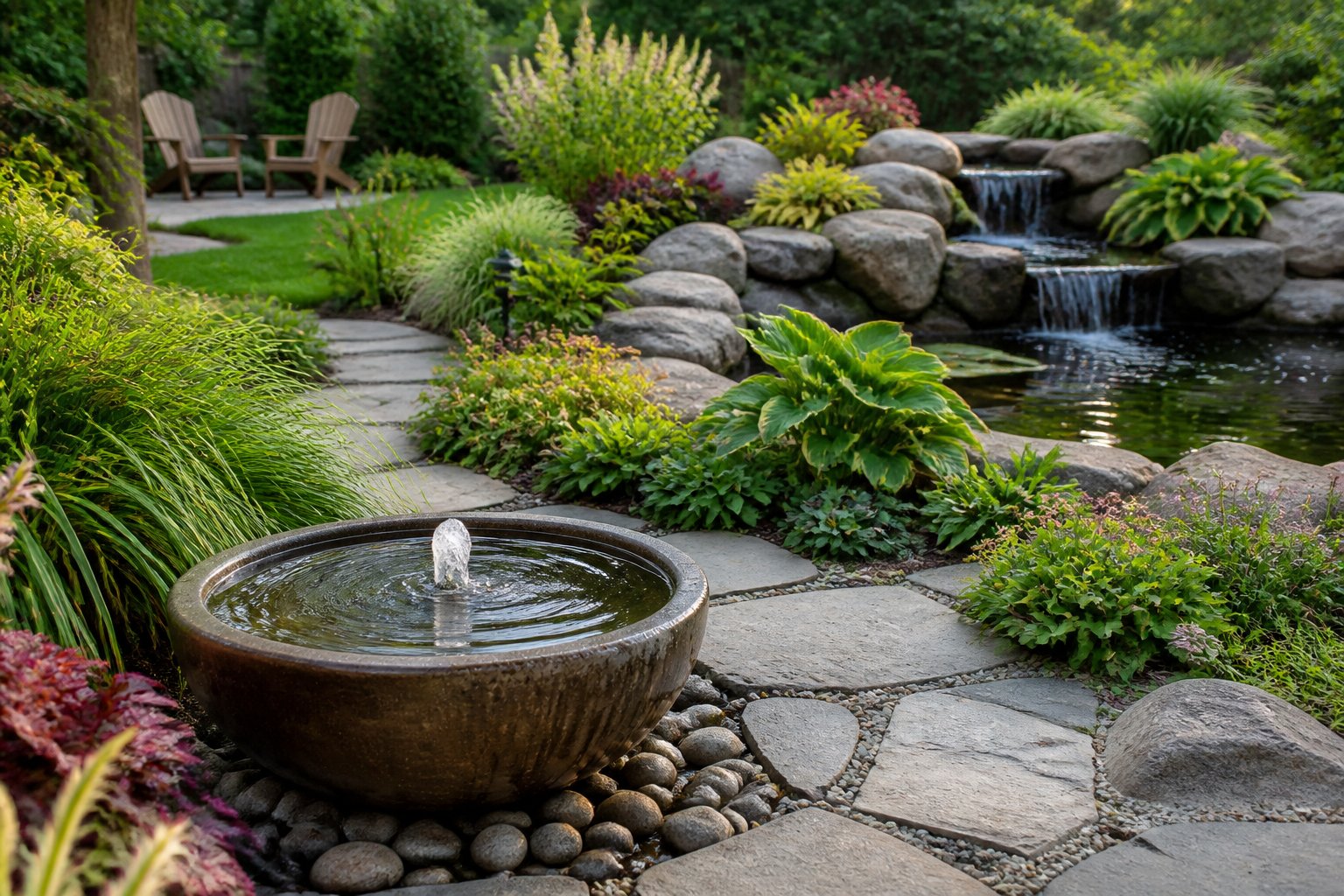
You’ve got options, even if your space is tight. A container water garden in a half whiskey barrel or stock tank can squeeze in for under $200 to $300.
Bubbling rocks over buried basins look great and don’t need much room. Wall-mounted fountains also fit neatly and keep plumbing hidden.
If you want something really cheap, try a solar bubbler in a birdbath. That one usually costs just $20 or so.
How can I make a cheap DIY water feature?
Grab a watertight container you have lying around, toss in a small submersible or solar pump, and cover the cord with plants or gravel. It’s honestly not complicated.
Seal the drain hole in a glazed pot, drop in a $30 pump, and you’ll get that real water sound for under $100. If you add hornwort or water lettuce, it turns into a little living garden—kind of fun to watch.
What is the easiest outdoor fountain to build on a budget?
A bubbling rock fountain is hard to beat for simplicity and impact. You just set a plastic basin in the ground, add a 150 to 250 GPH pump, and run tubing through a drilled stone.
Cover it up with hardware cloth and gravel to finish. Most folks can knock this out in a weekend for $75 to $150.
What are unique water feature ideas for a large backyard?
A meandering stream ending in a pondless basin gives you movement across a long sightline, but skips the open pool. It’s a clever way to get that flowing water vibe without the maintenance.
If you’re into wildlife, a pond with a shallow beach edge and native plants will bring in frogs and birds. On a slope, a multi-tier boulder cascade puts the natural grade to work for you.
How much does it cost to install a backyard pond or fountain?
DIY container and bubbling rock features usually run $75 to $300. A pondless waterfall costs $500 to $1,500 if you build it yourself, or $3,000 to $8,000 for a pro install.
Stocked ponds typically land between $1,000 and $6,000, but koi ponds and natural swim ponds? Those can get pretty pricey.
What materials do I need to create a simple outdoor water fountain?
You'll need a watertight vessel or a basin for the water. Grab a submersible pump that's the right size for your fountain.
Flexible tubing comes next, and you'll want access to a GFCI outlet—safety first, right? If you plan to bury the reservoir, toss in some hardware cloth or a grate.
River rock or decorative gravel works well to hide the pump and tubing. Honestly, a dechlorinator only matters if you're adding fish or plants.
DISCLAIMER
This document is provided for general information purposes only and should not be relied upon as providing legal advice, technical, or specific operational guidance to the reader, whether as to the practices described in the document or the applicable legal requirements and regulations. lawnfly.com expressly disclaims any responsibility for liability arising from or related to the use or misuse of any information in this document.


